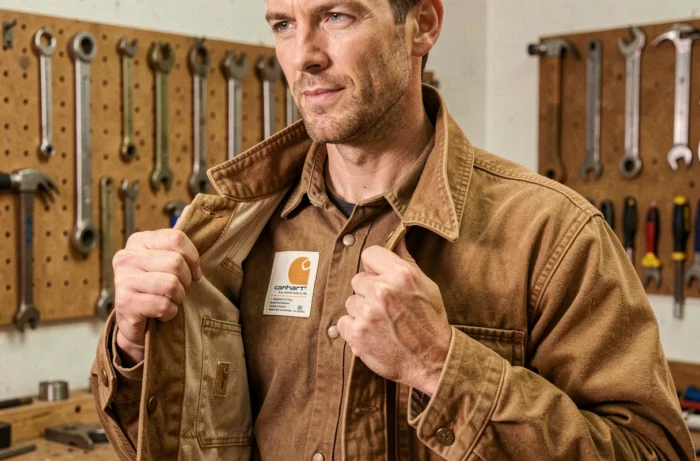
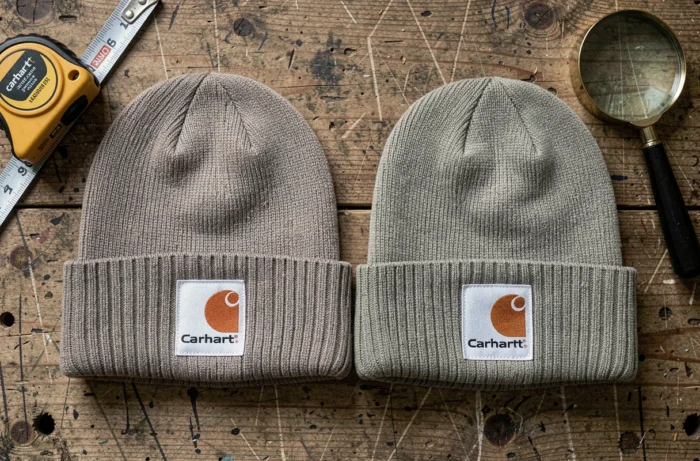
Carhartt clothing is among the most sought-after items on resale platforms, whether it’s vintage American workwear or the European Carhartt WIP line. This appeal fuels a counterfeit market that, while not widespread, targets specific styles: Detroit jackets, Watch Hat beanies and cargo pants. Buying online makes it harder to inspect a garment in person, and the seller’s status (private individual or business) determines what remedies are available if something goes wrong.
Carhartt Inc. and Carhartt WIP: two lines, two labeling systems
Before checking whether an item is authentic, you need to identify which line it belongs to. Carhartt Inc. is the workwear brand founded in Detroit in 1889, with its headquarters in Dearborn, Michigan. Carhartt Work In Progress (WIP) is a European licensee based in Hamburg since 1994, reinterpreting Carhartt silhouettes through a streetwear lens.
The two entities are legally and commercially distinct. They use different labels, cuts and style codes. Counterfeiters often mix labeling elements from both lines on the same garment, making this one of the most reliable signs of a counterfeit. A WIP label on a jacket sold as American workwear, or vice versa, immediately gives away a suspicious item.
For a closer look at the differences between these two lines and the checks to make, Construire la Bretagne’s guide to Carhartt details each authentication criterion by item type.
Carhartt labels and holographic strip: what the inside of the garment reveals
The inside label is the first thing to check, because it’s the detail counterfeiters reproduce least accurately. On Carhartt Inc. workwear, look for the “style number”, an alphanumeric code (for example, J131 for the Active Jacket) that corresponds to a model listed in the official catalog. This code should appear on the care label and match the garment’s cut, material and size.
On newer items, Carhartt includes a holographic strip on the care label. The strip changes its reflection depending on the viewing angle and is difficult to reproduce cheaply. Its absence doesn’t automatically mean an item is fake: vintage pieces and some older lines don’t have one.
Cross-checks on the care label
The typography on authentic Carhartt labels is crisp, consistent and free of smudges. On a counterfeit, the characters are often slightly blurry or uneven, or printed in a font that differs from the one used by the brand.
Checking the spelling of the name is a basic but remarkably effective first step. Any variation such as “Carhart” or “Carharrt” is a fake. The correct spelling has one “r” after the “h” and two final “t”s.
Embroidered logo, buttons and stitching: the details that distinguish a real Carhartt from a copy
Beyond the labels, the garment’s physical details provide clues that aren’t always visible in online photos, but a reputable seller will be willing to document them on request.
- The “C” logo is embroidered on authentic items, never simply printed. A printed logo that peels or cracks after a few washes indicates a counterfeit or fraudulent rework.
- Metal buttons feature a raised “Carhartt” engraving. On a fake, the engraving is flat or hard to read, or the buttons are generic and unbranded.
- Seams are double- or triple-stitched in high-stress areas (shoulders, pockets, crotch). An authentic Carhartt item has even stitching, with no loose threads or skipped stitches.
- The duck or canvas fabric used by Carhartt is heavyweight and feels stiff on new items. Fabric that feels too soft or too thin for the advertised style should raise concerns.
“Carhartt Brown”, the brand’s distinctive deep ochre shade, is difficult to reproduce exactly. Counterfeits often lean toward a duller or more orange-brown.

Online seller reliability: what labels can’t tell you
Authenticating the garment isn’t enough if the seller isn’t trustworthy. On a marketplace, the platform’s name doesn’t necessarily identify the actual seller. Before paying, check which country the seller is based in, what contact details they provide, and whether they’re a private individual or a business.
This distinction affects the remedies available. The 14-day right of withdrawal and the statutory guarantee of conformity don’t apply in the same way to sales between private individuals. On secondhand platforms, be especially cautious if a seller refuses to provide detailed photos of the inside label, style number or buttons.
Warning signs on a seller’s profile
An unusually low price is a red flag, but it’s not the only one. Check the seller’s profile history too: someone offering several sizes of the same rare style at once is probably reselling counterfeits. Generic photos, identical across multiple listings or clearly taken from an official website, are another recurring warning sign.
The Digital Services Act requires marketplaces to collect certain information about business sellers and make it available to buyers. For an unfamiliar website, comparing its legal notices and terms of sale can help you assess its reliability, although this alone doesn’t prove that a jacket is authentic.
Buying vintage Carhartt online: the limits of remote verification
Some newer checks don’t apply to a vintage piece from the 1990s. Holographic strips didn’t exist, labels changed over the decades, and finishes varied between production facilities. Dating a vintage Carhartt requires cross-referencing the style number with period catalogs, which calls for specific knowledge of the model in question.
Counterfeits of vintage items are still rarer than those of common styles, because recreating the natural wear of duck canvas worn for years is costly and not very profitable.
The main risk in the vintage market isn’t so much a complete fake as fraudulent rework: a generic item with a Carhartt patch sewn onto it. Checking that the patch is original (stitched as part of the garment’s construction, not added over an existing seam) is the best way to guard against this.
Remote authentication has practical limitations: fabric texture, garment weight and the quality of the button engraving can’t be checked from a compressed photo. If you’re still unsure, asking for a video of the holographic strip or a close-up photo of the inside seams can reduce the margin of error, though not eliminate it entirely.