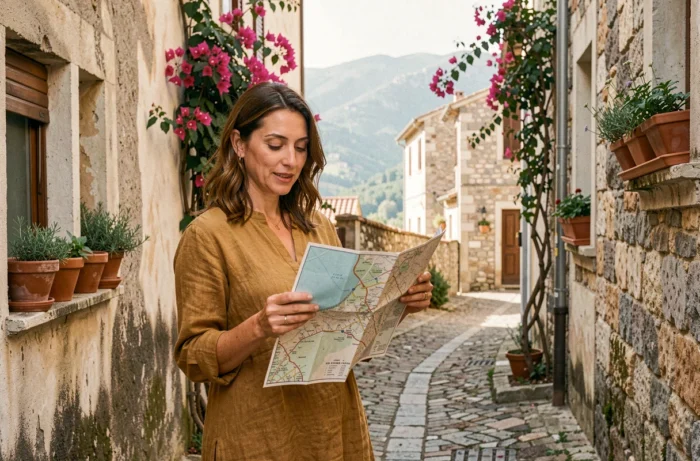
Heading south from Naples in a rental car seems simple on paper—until you find yourself facing a ZTL sign at the entrance to a historic center, unsure whether the camera has just snapped your license plate.
It’s details like this, far more than choosing between Matera and Lecce, that determine whether a southern Italy itinerary goes smoothly. This guide focuses on the practical constraints that can turn a string of destinations into a seamless trip.
ZTLs and parking: the constraint that shapes every itinerary in southern Italy
Limited traffic zones (ZTLs) are the costliest trap for drivers. Monitored by cameras, they operate according to schedules and exemptions that vary from one municipality to another. Naples, Lecce, Matera—even small villages in Puglia—have them.
The process is the same everywhere, but how it’s applied varies. Before arriving, contact your accommodation to ask whether it can register your license plate with the local police. Without registration, every time you pass a camera can result in a separate fine, and notices sometimes arrive months after you’ve returned home.
Information on ZTL schedules is scattered across various sources. If you’re planning an itinerary that also takes in the north of the peninsula, platforms such as cinqueterre-unpacked.com bring together useful practical information on getting around Italy. For the south, the rule is to check each municipality’s official website a few days before your visit, as operating hours may change during peak season.
In practice, plan to park outside the ZTL at every stop. In Naples, the underground car parks near the central station or port are the most accessible. In Matera, parking is available on the outskirts of the Sassi. In Lecce, car parks outside the historic center are signposted.

Planning a southern Italy itinerary without changing accommodation every night
Itineraries that involve changing accommodation every night are common. In practice, that means repacking every day, finding a new parking spot, registering your license plate again, and losing one to two hours with every move. For a ten-day trip, three or four fixed bases are enough to cover all of Puglia, Basilicata, and Campania.
Naples as a base for Campania
From Naples, you can reach Pompeii and Herculaneum by regional train (Circumvesuviana) in under an hour. The Amalfi Coast is accessible by ferry from the port or by SITA bus from Sorrento. Leaving the car in Naples and using local transport for these trips avoids the stress of narrow coastal roads and packed car parks.
Matera as a base for Basilicata
For most travelers, Matera is worth two nights, but no more. A full day is enough to explore the Sassi and the rock churches. The second day can be spent in the Murgia Materana Park, which is accessible on foot from the city. From there, it takes less than two hours to reach Puglia.
Lecce or Monopoli as a base for Puglia
The choice between Lecce and the Monopoli-Polignano area depends on what you want to see on day trips. From Lecce, you can explore Otranto, Gallipoli, and Salento. From Monopoli, you can reach Alberobello, Ostuni, and Polignano a Mare. If time allows, visit both in sequence, spending three nights at each base.
Getting around southern Italy without a car: what works and what doesn’t
It’s possible to travel around southern Italy without a car, but you’ll need to accept that some rail and bus connections are still infrequent. Investment in transport across the Mezzogiorno is underway, with several rail projects not expected to be completed until after 2030. Until then, you’ll need to work around the realities on the ground.
Routes that work well:
- Naples to Pompeii and Herculaneum on the Circumvesuviana, with departures every 20 to 30 minutes during the day
- Naples to Matera by bus (Flixbus or Marozzi), with a direct journey that avoids going via Bari
- Lecce to Bari by Trenitalia train, with regular service and a reasonable journey time
More challenging connections:
- Traveling from Matera to Lecce without a car means going via Bari or Taranto, with connections sometimes several hours apart
- Coastal villages in Salento (between Otranto and Gallipoli) are poorly served outside summer, when seasonal shuttles run
- Taking the bus along the Amalfi Coast can be exhausting in peak season, when the roads are narrow and the vehicles crowded
Check each connection on the Trenitalia website or the regional bus operator’s website before finalizing your itinerary. A connection shown on Google Maps doesn’t always run as frequently as the app suggests.

Beach access and seaside regulations in southern Italy
The coastline of southern Italy alternates between free public beaches (spiaggia libera) and beaches managed by private establishments (lidi). The balance varies considerably from one municipality to another. Along some stretches of the Puglian coast, most of the shoreline is occupied by beach concessions, leaving only narrow strips of free beach between two lidi.
Municipal beach regulations set the rules on dogs, wild camping, and permitted equipment. These regulations change from year to year. They’re usually available on the municipality’s website or posted at the beach entrance.
Beaches along the Amalfi Coast are often reached by steps cut into the rock. The beaches in Positano and Praiano are small and packed in July and August. If you want to swim without the crowds, head for the beaches of Cilento (south of the Amalfi Coast) or those in northern Salento, which get less attention.
When to go and how long to allow for a road trip in southern Italy
May–June and September–October offer the best balance of weather and visitor numbers. In July and August, the Amalfi Coast and Puglia’s beaches get so crowded that driving, parking, and finding a restaurant become much more difficult.
Ten days is the minimum for a Naples–Matera–Puglia itinerary if you don’t want to spend all your time in the car. With less time, skip either Matera or Salento. For trips longer than two weeks, you can add Calabria (Tropea, Scilla) or head north to the Gargano, the peninsula in northern Puglia that’s less crowded than the Bari–Lecce–Alberobello triangle.
Tourism isn’t spread evenly across the region. The province of Lecce has seen a notable increase in arrivals in recent years, but this growth affects the whole province, not just the city center. Coastal villages between Otranto and Santa Maria di Leuca attract some of these visitors, which means that even destinations known for being quiet can get surprisingly busy in peak season.
Southern Italy rewards those who are willing to slow down. A village without tourist signs, a trattoria with a handwritten menu, a cove without a lido: these moments can’t be planned, but they happen when your itinerary leaves enough breathing room between stops.