We buy a non-buildable plot of land to establish an orchard, store agricultural equipment, or simply to keep a family parcel. At this stage, the reflex is to focus on the price per square meter, which is often low. The notary fees, on the other hand, take a back seat, even though they represent a much heavier proportional share than for an apartment in the city. Understanding their composition avoids unpleasant surprises on the day of signing.
Transfer taxes on non-buildable land: the biggest expense
When purchasing land classified as natural or agricultural in the PLU, one sometimes expects a lighter tax regime. This is not the case. Transfer taxes apply at the same rate as for buildable land, because the tax administration does not distinguish between the nature of the plot when calculating this tax.
Transfer taxes (also called registration fees) make up the majority of the bill. They are paid to the State and local authorities. Their rate varies by department, and since April 2025, some departments have voted for a temporary increase. Therefore, one cannot rely on a single percentage valid everywhere in France: it is necessary to ask the notary for the applicable rate in the department where the land is located, on the scheduled date of the deed.
To estimate notary fees for purchasing land with Immowatcher, one can start from a global range of 7 to 8% of the purchase price. On land sold for a few thousand euros, this proportion makes the fees proportionally very visible compared to the price of the parcel.
Notary fees and disbursements: what actually goes to the office
The classic confusion is to believe that the notary pockets the entire amount paid. In practice, the notary’s remuneration represents only a fraction of the acquisition costs. The rest goes to the public treasury and covers administrative costs.
Regulated fees
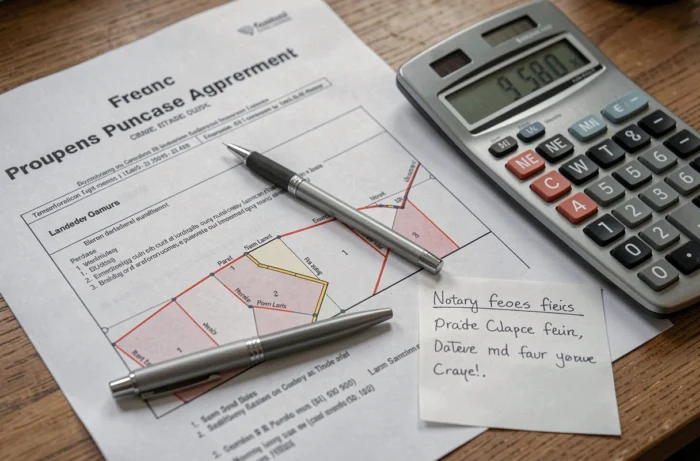
The notary’s fees are governed by a national decreasing scale, calculated in brackets based on the sale price. The lower the price of the land, the higher the rate applied to the first bracket. This explains why for a non-buildable plot sold at a low price, the share of the fees seems disproportionate.
The scale works as follows:
- On the bracket from 0 to 6,500 euros, the rate is approximately 3.87%, which is the highest tier
- Between 6,500 and 17,000 euros, it drops to about 1.59%
- Between 17,000 and 60,000 euros, the rate goes to about 1.06%
- Above 60,000 euros, it stabilizes around 0.80%
On a non-buildable plot sold for under 10,000 euros, the first bracket absorbs almost the entire price. The amount of the fees remains modest in absolute terms, but it weighs proportionally.
Disbursements and the real estate security contribution
Disbursements cover the costs incurred by the notary to obtain the necessary documents for the sale: cadastral extract, mortgage status, urban planning documents. The real estate security contribution finances the registration of the transaction with the land publicity service. These items are non-negotiable, regardless of the price of the land.
Agricultural land, leisure land, wooded parcel: do fees vary by use?
A non-buildable plot can be used for agricultural exploitation, leisure (garden, camping with permission), or simply left fallow. The question often arises: does the type of use change the notary fees?
The tax regime depends on the seller’s status, not on the intended use by the buyer. If the seller is a private individual or a professional not subject to VAT, the standard transfer taxes apply. If the seller is a professional subject to VAT (such as a land developer), the transaction may fall under a different regime with reduced fees, but this case remains rare for non-buildable land.
For agricultural land sold by a retiring farmer, we remain in the standard regime. The fact that the parcel is classified in zone A (agricultural) in the PLU does not change the calculation. The same applies to a wooded parcel classified in zone N (natural).
Risk assessment and checks before signing the sale deed
A non-buildable plot is not exempt from the obligation to inform about risks. The seller must provide a risk assessment if the parcel is located in a regulated area: natural risks (flooding, landslides), mining or technological risks, seismicity, radon exposure, coastal erosion, or obligations for clearing.
This document does not constitute a notary fee item per se. But an unfavorable risk assessment can reveal maintenance or usage constraints that affect the real value of the land. It is advisable to read it before signing the preliminary agreement, not after.
Furthermore, the temporary increase in transfer taxes voted by some departments since 2025 is not automatically renewed everywhere. The deadline for this measure varies according to local deliberations. The notary can confirm whether the increased rate still applies on the scheduled signing date, which can represent a significant difference in the final amount.
The total notary fees for non-buildable land range between 7 and 8% of the price, with no tax advantage related to the non-buildable nature of the parcel. On often modest purchase amounts, these fees should be integrated from the start into the budget, lest the real cost of the operation far exceed the displayed price.