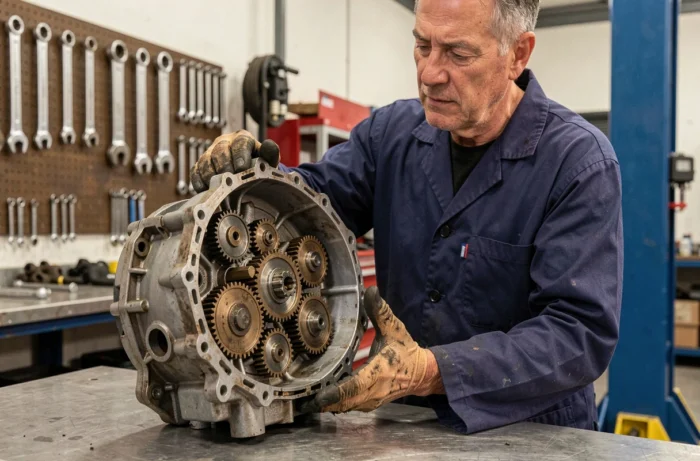
When you change gear, a mechanical ballet unfolds under the hood in a matter of tenths of a second. The gearbox connects the engine to the wheels and adjusts the power delivered to suit the situation: starting on a hill, accelerating on the highway or maneuvering into a parking space. Understanding its components makes it easier to interpret unusual noises and talk to a mechanic without feeling out of your depth.
Why the engine needs a gearbox to move the car
An internal combustion engine does not produce the same amount of force at every engine speed. At low RPM, it lacks the torque needed to get the car moving. At high RPM, it spins quickly but wastes fuel without delivering any real increase in speed.
The gearbox solves this problem using gear ratios. Each ratio consists of a pair of gears of different sizes. A small gear driving a larger one multiplies torque, which helps the car get moving. The reverse arrangement favors cruising speed.
In practical terms, shifting from first to fifth means choosing pairs of gears that are increasingly similar in size. The engine stays within its most efficient RPM range, and the wheels receive exactly the force they need. If you have ever ridden a multi-speed bicycle, the principle is the same: use the small chainring to climb and the large one to ride fast on flat ground.
This page detailing the components of a car gearbox provides more information on the technical names of each part.
Clutch and transmission shafts: the parts that set things in motion
Before the gears even come into play, two components prepare the way.
The role of the clutch
Have you noticed that, in a manual car, you need to press the pedal on the left to change gear? The clutch temporarily disconnects the engine from the gearbox. Without this interruption, the gears would be spinning at different speeds during a shift, causing grinding and rapid wear.
The clutch mainly consists of a friction-lined disc, a pressure plate and a flywheel. When the pedal is released, the disc presses against the flywheel and transmits rotation. When the pedal is pressed, the disc disengages and power transmission is interrupted.
Input shaft and output shaft
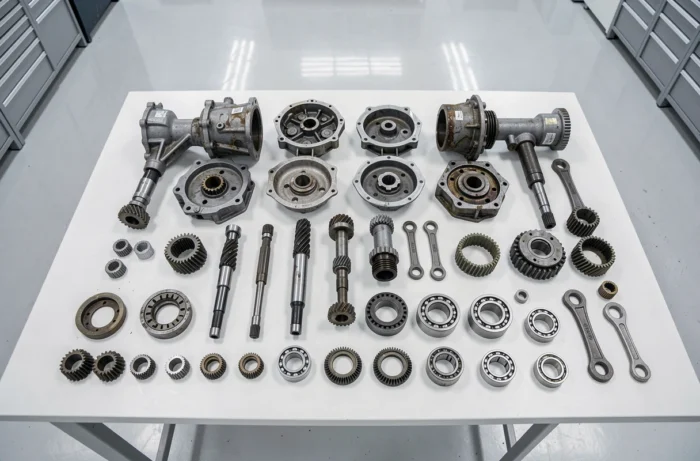
Once the clutch is engaged, rotation enters the gearbox through the input shaft. This shaft carries gears that mesh with those on the output shaft. The input shaft receives motion from the engine, while the output shaft transmits it to the wheels.
In the most common front-wheel-drive gearboxes, these two shafts are parallel. Selecting a gear engages a specific pair of gears between the shafts, changing the speed and torque delivered to the wheels.
Synchronizers and shift forks: smooth gear changes
Changing gear seems simple from the driver’s seat. Inside the gearbox casing, the mechanics are more subtle.
How a synchronizer works
The gears on the output shaft spin freely at all times. Selecting a gear means locking a specific gear to its shaft. That is the job of the synchronizer.
This cone-shaped ring briefly rubs against the selected gear to equalize their rotational speeds. Once both are turning at the same speed, a sliding sleeve locks them together. The shift happens without a jolt or noise, provided the clutch has properly disconnected the engine beforehand.
Shift forks
When you move the gear lever, a linkage or cable operates metal shift forks inside the casing. Each fork pushes or pulls a sliding sleeve toward the corresponding gear. Two or three forks are enough to cover the five or six gears in a typical manual gearbox, because each sleeve can slide in two directions.
Differential and casing: the often-overlooked parts
Integrated differential
In a front-wheel-drive car, the differential is often housed in the same casing as the gearbox. Its purpose is easy to understand: when cornering, the outer wheel travels farther than the inner wheel. The differential allows the two wheels to turn at different speeds while receiving power from the same shaft.
Without a differential, the tires would scrape against the road when cornering, causing rapid wear and unstable handling. This component, which uses bevel gears (or planetary gears, depending on the model), is the final step before engine power reaches the wheels.
The casing and gearbox oil
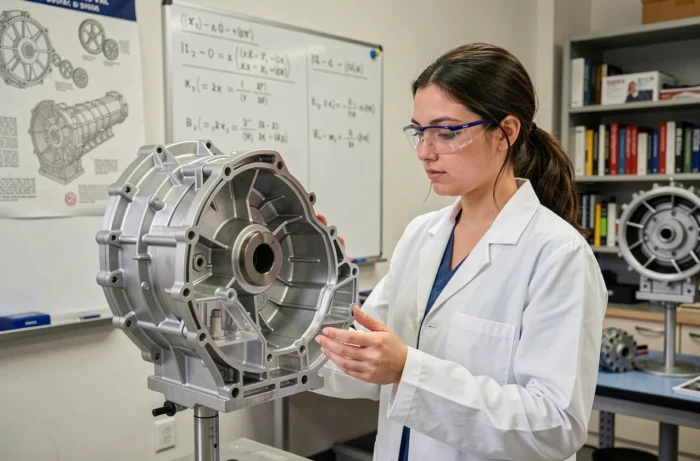
The casing is the metal housing that protects the entire assembly. It holds the shafts in position with bearings and contains the transmission oil. This oil reduces friction between the gears and dissipates heat. Insufficient oil accelerates wear on the synchronizers and gear teeth.
Unlike engine oil, gearbox oil needs changing less often, but it does not last forever. Changing it at the intervals recommended by the manufacturer helps prevent stiff or noisy gear changes.
Gearbox components at a glance
Here are the main parts and what they do, in the order of the mechanical power flow:
- Clutch: disconnects and reconnects the engine and gearbox to allow gear changes without forcing the gears.
- Input shaft: receives rotation from the engine via the clutch and transmits it to the gearbox’s internal gears.
- Output shaft: carries the output gears that send torque to the differential and then to the wheels.
- Synchronizers and sliding sleeves: equalize rotational speeds, then lock the selected gear to its shaft.
- Shift forks: translate movement of the gear lever into movement of the sleeves inside the casing.
- Differential: distributes torque between the two drive wheels while allowing them to rotate at different speeds when cornering.
- Casing and transmission oil: protect, support and lubricate all the internal components.
Each part depends on the condition of the components around it. A worn clutch disc puts extra strain on the synchronizers, while worn synchronizers make gear changes less precise. Keeping an eye on the clutch and changing the gearbox oil at the recommended intervals are the most direct ways to protect the transmission over time.