Choosing an easy sport to take up means weighing three simple factors: the time it takes to get ready for each session, the cost of getting started, and the risk of joint injuries. When you compare activities against these criteria, a few clearly stand out.
According to the benchmark set by Santé publique France, adults should aim for the equivalent of at least 30 minutes of moderate-to-vigorous physical activity per day, at a pace that still allows them to hold a conversation. So the question isn’t which sport is the most spectacular, but which one you’ll still be doing six months from now.
Comparing accessible physical activities: time, cost and impact on joints
| Activity | Time to get ready | Minimum equipment | Impact on joints | Can be done alone |
|---|---|---|---|---|
| Brisk walking | Less than 5 min | Suitable shoes | Low | Yes |
| Leisure cycling | 5 to 10 min | Bike, helmet | Very low | Yes |
| Swimming | 15 to 20 min (travel, changing) | Swimsuit, goggles | Almost none | Yes |
| Yoga | Less than 5 min | Mat | None | Yes |
| Running | Less than 5 min | Running shoes | Moderate to high | Yes |
The table highlights a clear difference between activities with no or low impact and running, which is often described as the easiest sport to take up. Brisk walking and leisure cycling offer the best balance between accessibility and protecting your joints. Although swimming has almost no impact on the joints, it requires travel and a set time slot, adding to the time needed to get ready.
Finding an easy sport to take up means looking beyond the session itself: it’s often the logistics around exercise that lead people to give up.
Walking and cycling: why these two activities top the comparison
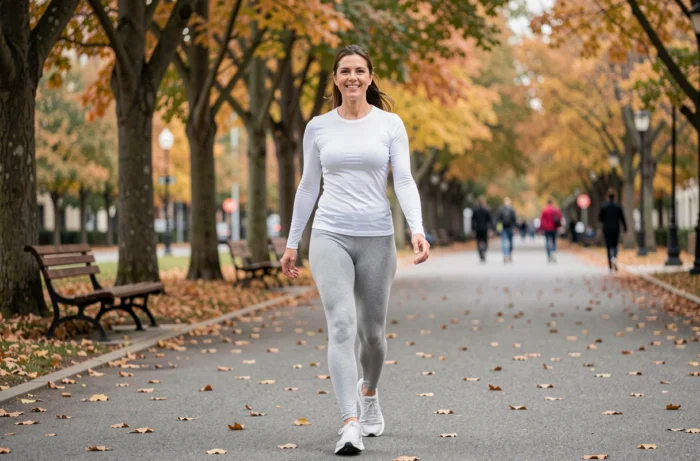
Brisk walking offers plenty of benefits without demanding much in return. No membership, no changing room, no partner needed. You can naturally find your pace: slightly out of breath, but still able to hold a conversation. This simplicity explains why French public health recommendations rank it among the top activities encouraged for adults.
Even when spread throughout the day, brisk walking helps you meet your activity goals. Three 10-minute bouts provide benefits comparable to one continuous 30-minute session. For someone with only short breaks, splitting up the activity removes the excuse of not having enough time.
Leisure cycling shares most of these benefits, with one added advantage: it puts even less strain on the joints because your body weight rests on the saddle. However, the cost of getting started is higher (buying or maintaining a bike), and cycling depends more on the weather and local cycling infrastructure.
When running becomes a trap for beginners
Running features in most lists of accessible sports. Its appeal is real: all you need is a pair of shoes and somewhere to run. But its moderate-to-high impact on the joints makes it less suitable when returning to exercise after a long period of inactivity. Your knees and ankles absorb several times your body weight with every stride.
Starting with brisk walking, then alternating between walking and running over several weeks, reduces this risk. Going straight into running without preparation is the main reason people give up when returning to exercise.
Home workouts without equipment: yoga and bodyweight exercises
If getting to a venue is the main obstacle, two options stand out: yoga and bodyweight exercises (squats, push-ups, planks). Both can be done in a small space without expensive equipment.
Yoga has a distinctive profile in this comparison. It puts no strain on the joints, takes almost no time to get ready for, and online resources (videos, apps) make it easy to follow guided sessions at home. Yoga gently builds strength without impact or sudden movements, making it suitable for mild back pain, provided you avoid advanced poses.
Bodyweight exercises offer a different benefit: targeted muscle strengthening. A few guidelines can help you structure an effective workout without overcomplicating things:
- Choose three or four compound movements (squats, push-ups, lunges, planks) rather than isolation exercises that require equipment
- Aim for short sets with enough rest to maintain good form
- Gradually increase the number of repetitions, not the complexity of the movement
This approach works just as well for someone who has never exercised as it does for someone returning to sport after several years.
Spend less time sitting: an often-overlooked complementary approach
Getting active and reducing sedentary time are two distinct but complementary goals. A brisk walk in the morning doesn’t make up for sitting in front of a screen for eight hours straight. French recommendations stress the importance of regularly breaking up periods of sitting with short bursts of activity.
In practice, getting up for a few minutes every hour, walking during a phone call or taking the stairs are small activities that add to your exercise routine without requiring any planning. For people looking for the least demanding option, these everyday adjustments are a realistic starting point, even before choosing a sport.
Maisons Sport-Santé: free support to help you get started
In France, Maisons Sport-Santé help people find activities and professionals suited to their individual needs. The service is available to both sedentary people and those living with chronic conditions. Personalized support reduces the risk of choosing an unsuitable activity and giving up after a few weeks.
- An initial assessment to evaluate fitness and identify any potential contraindications
- Referrals to supervised adapted physical activity sessions led by trained professionals
- Ongoing follow-up to adjust the activity as you progress
This structured approach meets a need that motivation alone can’t address: knowing where to start when you’re starting from scratch.
The easiest sport to take up isn’t the one at the top of a ranking, but the one with such simple logistics that there’s no room for hesitation. Brisk walking meets this criterion better than any other activity. Adding active breaks to your day and, if you need guidance, getting support from a Maison Sport-Santé completes the picture without making everyday life more complicated.