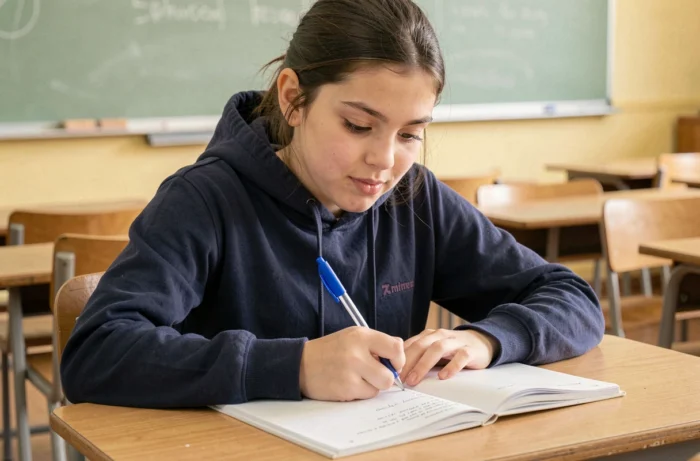
In Year 9, writing assignments often alternate between storytelling and argumentation. The French curriculum expects students to master several forms of writing: narrative, description, dialogue and opinion pieces. Offering a range of topics with sample answers makes it possible to practise each skill in a focused way, while still leaving plenty of room for imagination.
Year 9 writing sample answers: what a model text is for
A sample answer is not a text to copy. Its purpose is to show how a prompt can be turned into practical choices: which verb tense to use, where to start a new paragraph, and how to link two ideas without repeating the same transition word.
Before reading the sample answer, students benefit from rereading their own work and looking for one specific issue. For example: “Does each paragraph contain just one idea?” Research on sentence-level revision shows that revising a text in several stages improves the final result. The sample answer is therefore a point of comparison, not the only right solution.
By regularly working with a writing prompt with a sample answer, students learn to spot their recurring mistakes and develop their own proofreading habits.
Year 9 creative writing prompts: three ideas and guidance for marking

Creative writing makes up a significant part of writing assignments in secondary school. Here are three prompts designed to encourage students to go beyond a straightforward, linear narrative.
Prompt 1: a character who changes perspective
Prompt: “An everyday object (a phone, a bicycle, a pair of shoes) tells the story of its day in the first person.” This prompt requires students to step outside their usual perspective. The sample answer can show how to give the object its own voice: sensory vocabulary (wear, warmth, weight) and short sentences to reflect the object’s simplicity.
Prompt 2: the twist ending
Prompt: “You are alone in a country house. A noise wakes you in the middle of the night. Tell the story, building towards an unexpected ending.” Here, the sample answer breaks down how to create suspense: delay the final reveal with sensory descriptions. Students learn to control how much information they reveal to keep the reader on edge.
Prompt 3: invent a rumour, then debunk it
Prompt: “Write a short text about an extraordinary event at your school. Then, in a second paragraph, show that it is misinformation.” This prompt combines imagination with critical thinking. The sample answer highlights the techniques that make a text seem credible (specific details, an invented quote) and those that can be used to debunk it.
Writing prompts with dialogue and diary entries: writing in the first person
Writing “I” in a school assignment does not always come naturally. Diary entries and dialogue each come with specific technical requirements.
Prompt 4: a diary entry after a memorable event
Prompt: “Your character has just taken part in their first sports competition (or attended their first concert). That evening, they write in their diary.” The sample answer focuses on two points: combining emotions with concrete details, and using the present or present perfect to create a sense of immediacy.
Prompt 5: an argumentative dialogue between two characters
Prompt: “Two friends are talking. One wants to adopt a pet, while the other thinks it is not the right time. Write their conversation, using the correct dialogue format.” The sample answer checks dialogue punctuation (dashes and a variety of speech tags) and the progression of the arguments.

Prompt 6: a fictional letter to a historical figure
Prompt: “Write a letter to a historical figure you have studied in class, asking them three questions about their era.” This prompt brings French and history together. The sample answer shows how to follow the conventions of a letter (greeting, appropriate register) while asking questions that reflect genuine curiosity.
Descriptive and argumentative writing prompts to make progress in Year 9
Description and argumentation are both assessed in the French GCSE. Working on them from Year 9 gives students a real head start.
Prompt 7: describe a place that evokes an emotion
Prompt: “Describe a real or imaginary place that makes you feel fear, joy or melancholy, without ever naming the emotion.” The challenge is to evoke a feeling without stating it. The sample answer highlights the choice of vocabulary and the order of the description (from general to specific, or vice versa).
Prompt 8: an opinion piece on an everyday issue
Prompt: “Should mobile phones be banned at school? Write an argumentative text with at least two arguments and one example for each.” The sample answer suggests a clear structure:
- An introduction that sets out the debate in one or two sentences and gets straight to the point
- Two argumentative paragraphs, each following the argument-example-explanation structure
- A conclusion that states a position without repeating the arguments word for word
Prompt 9: rewrite a passage from a novel from a different narrator’s perspective
Prompt: “Choose an extract studied in class. Rewrite it from the point of view of a minor character.” This prompt develops close reading skills. The sample answer compares the two versions to show how changing the narrator alters the meaning of the story.
Prompt 10: create a character in five sentences
Prompt: “In exactly five sentences, introduce a fictional character. Each sentence must provide new information: appearance, personality, habit, secret, ambition.” This formal constraint encourages precision. The sample answer checks that each sentence fulfils its purpose and that the portrait as a whole is coherent.
- Creative writing prompts (1 to 3) develop creativity and narrative structure
- First-person prompts (4 to 6) develop emotional expression and mastery of writing conventions
- Descriptive and argumentative prompts (7 to 10) directly prepare students for the expectations of the French GCSE
Each prompt is worth revisiting after reading the sample answer. Rewriting a text after analysing it is the best way to improve your writing. The goal is not to produce a perfect first draft, but to learn to identify what works and what could be improved, one prompt at a time.