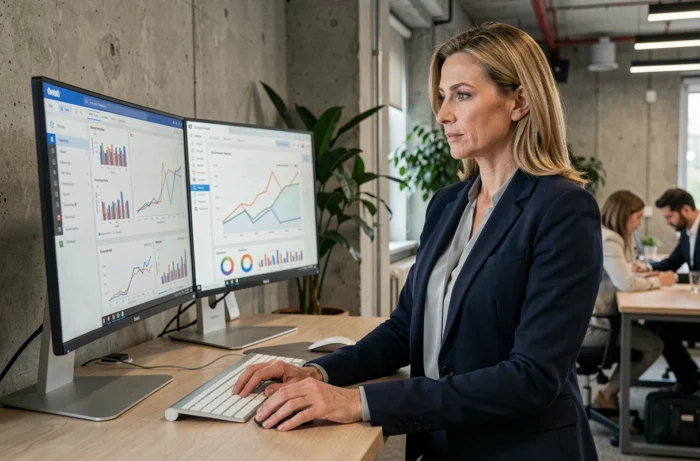
An invoice received by email, automatically filed, then matched to the purchase order without human intervention. Digital management tools do more than replace paper: they change how teams collaborate, make decisions and handle unexpected issues in their day-to-day work.
E-invoicing: a project that reveals the true state of internal management
Articles about digital transformation often focus on CRM systems, collaboration suites or the cloud. Yet e-invoicing is currently driving a large share of the practical efforts underway at small and medium-sized businesses.
The rollout has begun, and early feedback from the field points to uneven workflows. According to Les Échos, some small businesses were slow to activate their e-invoice reception systems, while others began issuing electronic invoices before they were required to. The Ministry of the Economy also notes that businesses are encountering practical implementation challenges, particularly when choosing a compatible platform and adapting their internal processes.
Already have accounting software? That may not be enough. You need to check that your tool can issue and receive invoices in the required format, then transmit the data to the public portal. Several businesses, including those supported by datta.fr, have had to review their invoicing workflows to adapt to this reform. This is more than a simple technical adjustment: it is a full-scale test of an organisation’s digital maturity.
Automating repetitive tasks: where the real gains lie
When people talk about digital transformation, automation quickly enters the conversation. The term often brings to mind ambitious scenarios. In practice, the most tangible gains come from modest but frequent tasks.
Three practical examples of accessible automation
- Bank reconciliation: management software compares accounting entries with bank statements, then flags any discrepancies. When done manually, this task takes up a disproportionate amount of the accounting team’s time relative to the value it adds.
- Payment reminders: a configured tool automatically sends reminders after the due date, without involving the administrative team. Automated reminders measurably reduce average payment times.
- Dashboard generation: instead of compiling data in a spreadsheet every Monday morning, a dashboard connected to data sources (sales, inventory, cash flow) displays metrics in real time.
A common mistake is trying to automate everything at once. Starting with a single time-consuming, well-understood task delivers results faster than a poorly planned, company-wide rollout.
Everyday cybersecurity: the blind spot for digitised SMEs
The more a business digitises its processes, the more it exposes its data. The connection is logical, but many business owners only realise it after an incident.
The cyber threat overview published by ANSSI highlights the continued targeting of SMEs by ransomware. The problem is not just technical. According to Clubic, a significant proportion of very small and small businesses have neither a formal backup policy nor a business continuity plan in the event of an attack.
Why the gap? Because cybersecurity is often seen as an IT issue, when in fact it is part of day-to-day management. Deciding who can access what, backing up critical data offline and regularly testing data recovery: these steps do not require a substantial budget, but they do require organisational discipline.
Three management measures—not just technical ones
- Set out access rights for management tools (accounting, CRM, shared files) in writing, and review them whenever an employee joins or leaves.
- Schedule automatic backups to a device disconnected from the main network, and regularly check that they are intact.
- Train every employee in basic security practices (checking the sender, reporting anything unusual) rather than placing responsibility on a single person.

Digital management tools: choose based on the problem, not the latest trend
ERP systems, CRMs, collaboration suites, project management tools: the list of available solutions grows every year. The natural instinct is to compare features. The more useful approach is to start with the problem you need to solve.
A business whose main pain point is tracking quotes and following up with prospects will get more value from a simple CRM than from a full ERP system it will only use halfway. Conversely, a business managing inventory, production and invoicing needs an enterprise resource planning system to avoid entering the same data into multiple software tools.
A tool adopted by the team is better than a powerful tool nobody uses. Ease of use, the quality of support in French and compatibility with existing processes matter more to a successful rollout than the number of features listed in a brochure.
The cloud has made these solutions easier to access: no server to install, automatic updates and access from any device. But this flexibility has a downside. Signing up for multiple tools that do not communicate with one another recreates the information silos that digital transformation was supposed to eliminate.
The key question to ask before taking out any new subscription: will this tool integrate with the ones already in place, or add another layer that nobody will maintain six months from now?
Digital tools only transform business management when they are adopted following a thorough assessment and a gradual rollout. The ongoing e-invoicing transition makes this clear: the technology is available; adapting processes is what takes time. A modest tool that is well integrated into everyday practices delivers better results than a full suite that is underused.