
Tire physics determine everything else. A poorly calibrated tire model turns any title into a rough experience, regardless of its graphics or the number of licensed vehicles. It’s the criterion that separates worthwhile racing games from interchangeable products.
Tire models and physics simulation: what makes the difference
The behavior of a virtual vehicle depends on how the physics engine calculates grip, heat deformation, and wear for each tire. Assetto Corsa remains the benchmark in this area thanks to a contact patch model that accounts for pressure, surface temperature, and vertical load in real time.
Le Mans Ultimate takes this approach further with endurance racing. Over stints lasting several hours, gradual tire degradation changes lap times in a nonlinear way. Drivers must adjust their racing line, braking, and fuel management based on the tires’ actual condition—not a simple wear indicator.
By contrast, arcade titles such as Forza Horizon 5 deliberately simplify these parameters. Grip is generous, understeer is almost nonexistent, and traction loss only occurs in extreme situations. This design choice isn’t a flaw: it serves the goal of delivering instant enjoyment in an open world, where smooth gameplay takes priority over mechanical fidelity.
We find that most players move between these two extremes depending on their mood. Among the car racing games available, the choice of physics model has a greater impact on the experience than a list of cars or tracks.
Sim racing and real-world competition: a two-way bridge
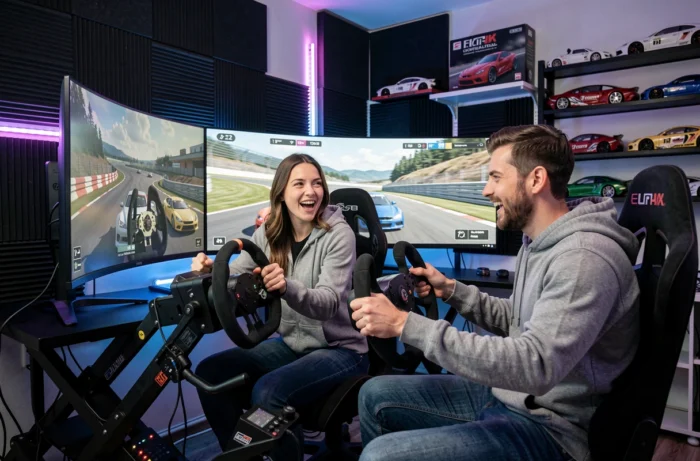
Sim racing is no longer a hobby disconnected from professional motorsport. The American Formula Sim Series used iRacing’s Time Attack format to identify potential drivers. Selection wasn’t based on raw speed alone: consistency, judgment, and racecraft were also part of the evaluation.
For Formula 1 teams, simulators are used as everyday development tools. Virtual drivers recreate specific race conditions to test tire strategies or aerodynamic setups before a Grand Prix.
Professional simulators are nothing like consumer games. The data they generate feeds directly into a team’s performance models. The line between recreational simulation and engineering tool lies in the feedback loop: when virtual results influence decisions made on a real track, it’s no longer entertainment.
Longevity of online games: the risk of always-online requirements
A racing game can disappear overnight if its publisher shuts down the servers. The Crew lost official access in March 2024 after its online infrastructure was shut down, even though the game offered substantial single-player content.
The Crew 2 received different treatment. An offline update released in October 2025 preserved part of the experience after multiplayer service ended. This remains the exception.
For players who invest hundreds of hours in a virtual garage, this should factor into their choice of game. Here are the criteria to check before buying:
- Full offline mode: Can the game be played without an internet connection, including for single-player progression?
- Publisher track record: Have they shut down servers before without offering an alternative?
- Community support: Does the game have mods or private servers that can take over (as is the case with Assetto Corsa)?
- Technical architecture: A game that requires a permanent connection to validate every action (always-online DRM) is inherently more vulnerable than one with an optional dedicated server

Arcade vs. simulation: choose based on your hardware and expectations
Your input device often settles the debate. A title such as Assetto Corsa Competizione, designed for GT racing, loses much of its appeal when played with a controller. Force feedback from a direct-drive wheel conveys changes in grip that a gamepad can’t reproduce.
By contrast, Forza Horizon 5 and Wreckfest work perfectly well with a gamepad. Their driving models include assists and tolerance ranges that compensate for the lack of precise haptic feedback.
The following table summarizes the key differences:
| Criterion | Simulation (Assetto Corsa, Le Mans Ultimate) | Arcade (Forza Horizon 5, Wreckfest) |
|---|---|---|
| Recommended input device | Wheel + pedals | Controller |
| Physics model | Tires, aerodynamics, heat | Simplified, focused on fun |
| Learning curve | Steep; several hours to achieve consistency | Immediate |
| Replayability | Online competition, telemetry, setups | Open world, seasonal events |
Hardware costs can easily exceed the price of the game. An entry-level direct-drive wheel with pedals and a stand is a significant investment. For a casual console player, an arcade title on Xbox or PlayStation offers much better value for money.
The choice between simulation and arcade isn’t a question of quality, but of purpose. A driver preparing for a club racing season will benefit from iRacing or Assetto Corsa Competizione. A player who wants to cruise across Mexico in a supercar after a day at work will find what they’re looking for in Forza Horizon 5. Both approaches coexist because they meet different needs, and the current trend is toward specialization rather than convergence.